Two Historical Films on Marijuana
Click Below To View The Two Films
Comments Please
IF YOU WOULD ALSO LIKE TO SEE RAMBLING ROY’S VIDEOS ABOUT RETIREMENT AT LAKE CHAPALA VIEW PROMOS BELOW AND THEN BUY
Expatriates living at Lake Chapala have a few things in common, coming from all over the world; they bring enthusiasm, creativity, knowledge, experiences and skills. In this video join Margarita and Roy, a couple of adventurous expats as they search for a new home in this fascinating location.
$10.00Add to cart
Not finding what they were looking for on the north shore Margarita and Roy continue their search for their new home on the south side of the lake.The south side of Lake Chapala is very different from the much busier north shore. Mostly, agricultural and fishing villages. It’s very rural, and very tranquil with only a few foreigners live here.
$10.00Add to cart
This action-packed video features the stories of 30 retirees who are part of the expatriate community that has formed itself at Lake Chapala, Mexico. They show us how they are pursuing their dreams and finding satisfaction in retirement.
$10.00Add to cart
IF YOU WOULD ALSO LIKE TO SEE RAMBLING ROY’S OTHER VIDEOS VIEW PROMOS BELOW AND THEN BUY
Last Free Ride
To see the full video click on the red button below and buy through PayPal.
Last Free Ride complete 85 minute video $10
$10.00Add to cart
No matter what videos are added to the cart they will be totaled in your shopping cart
BEST PRICE – 3 Videos – $20 USD
Or If You Want 2 Videos – $15 USD
Or If You Want 1 Video – $10 USD
Note: These videos can only be streamed [instant viewing]. DVDs or downloading are not available.
Check Cart Below
Film Reviews For Marijuana Films
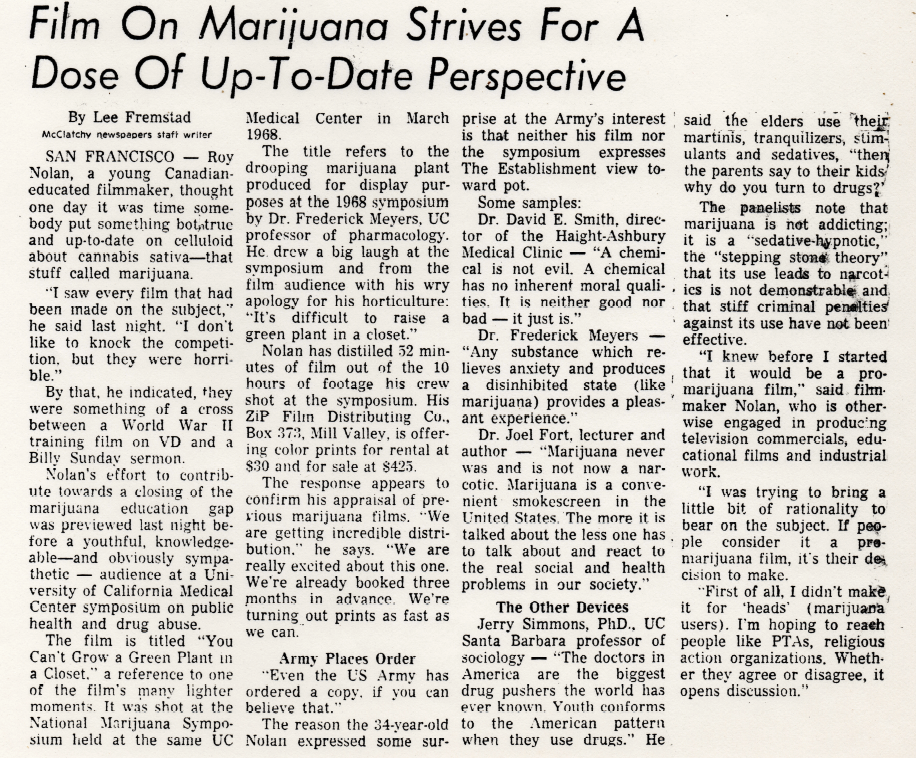
Review of ” You Can’t Grow A Green Plant In A Closet “
Speakers:
Joe Fort, M.D., Lecturer and Author, The Pleasure Seekers
David E. Smith, M.D., Medical Director Haight-Ashbury Medical Clinic
Price Cross, M.D., Lecturer and Author, Black Rage
James Carey, Ph.D., Professor of Criminology, University of California, Berkeley
Frederick Meyers, M.D., Professor of Pharmacology, U.C Medical Center, San Francisco
Eugene Smith, former Federal Probation Officer
William McGlothlin, Ph.D., Psychologist, Government Affairs Institute, U.C.L.A.
Alexander T. Shulgin, Ph.D., Professor of Sociology, University of California, Santa Barbara
Lewis Yablonsky, Ph.D., Chairman, Department of Sociology, San Fernando State College and Author, The Hippie Life
Evaluation:
Whether or not one agrees with the conclusion drawn by the authoritative speakers, it is hard to quarrel with their facts. And such facts are not often available in the popular media. The iconoclastic opinion are even rarer — which recommends the film to those interested in a balanced assessment of all sides in the growing national controversy over marijuana.
Audience and Uses:
- Sophisticated high school and college students would certainly open up with new respect and trust to any drug education course in which this film was used. Chances are, though, that they could recite most of the arguments from memory already.
- The film is practically indispensable to any program of adult or teacher education, if for no other reason than that it will alert participants to the kinds of pro arguments they must be prepared to contend with.
- An eye-opener for parent groups, law enforcement agencies, community organizations and general audiences.
Some Provocative Quotes From You Can’t Grow A Green Plant In A Closet:
” We emphasize that a chemical agent in itself has no moral qualities. We must determine the abuse potential, the patterns of use, and then make our decisions on such an objective basis. “
– David Smith, M.D., director, Haight-Ashbury Medical Center
” Marijuana, along with the barbiturates and the general anesthetics, can be classifies as a sedative-hypnotic. The pharmacological effects are pretty much identical. “
– Fredrick Meyers, M.D., professor of pharmacology, University of California Medical Center, San Fransisco.
” Marijuana is not now, and never was, a narcotic. And the term ‘soft narcotic’ scientifically makes as much sense as ‘soft pregnancy! It’s a deliberate effort to tie in marijuana and LSD with the successfully created demonology about heroin. “
– Joel Fort, M.D.
” Marijuana doesn’t have the spiritually redeeming side-effect of alcohol—the morning-after hangover. “
– Roger Smith, Ph.D., criminologist, former federal probation officer.
” In talking about one drug, we have to consider the real context, which is all drugs. For example, I could talk about aspirin for 30 minutes, I could recite the fact that several thousands of young people die from aspirin each year, that it is toxic, that studies have shown it causes birth defects in lower animals, that no one knows how it effects the brain and body… and then I could call for a five-year prison sentence for possession of aspirin…. “
– Joel Fort, M.D
” Arrest and expulsion from school and labeling as a marjuana user doesn’t do much toward rehabilitation. In fact, one of the best ways to assure continued drug use on a larger scale upon release [ is incarceration ]. “
– Roger Smith Ph.D.
” Marijuana is used more as a turn-off device among violent criminal gangs, to turn off the very negative environment around them. I would refer to this as the tradition approach—the ‘ fun and games’ and kicks approach, as an effort at euphoria. Only in the last few years has it gained the other social context, to ‘tune in’ to cosmic consciousness or to the unity of all man. “
– Lewis Yablonskit, chairman, sociology department, San Fernando State College.
” Youth conform to the American pattern when they take drugs because ours is a medical intervention society. American doctors are the biggest drug pushers the world has ever known. We use drugs to ‘fix’ ourselves to be ‘right.’ “
– Jerry Simmons, professor of sociology, University of California at San Diego.
It is estimated that twenty million Americans have had experience with marijuana, and yet in most states such an experience can bring a felony conviction with a sentence of up to ten years. Many experts now feel that such harsh penalties were established at a time when little was known about the drug, and youth by the millions are now supporting this position by smoking pot. What are the facts about marijuana? Is it a narcotic? Does it lead to heroin addiction, or LSD use? Who puts up the barriers to research? This film assembles many of the country’ top drug experts for a contemporary, scientific presentation on marijuana to aid you in obtaining accurate information on this most important subject. It has been rated among the top eleven of 99 reviewed in the D.C Extension Media Center’s 9 Films on Drugs.
A group of eminent medical doctors, sociologists, and psychologists speaks to a large audience about the myths and morals which have obscured and distorted some of the facts about marijuana. In an effort to further enlighten people about the controversial drug and adjust the many negative attitudes toward it, caption-identified speakers present the following points: the legal drinking of alcohol is much the same as , and in many cases worse than the illegal smoking of marijuana; unlike cigarettes, pot is physically non habit forming: grass does not necessarily lead to the use of hard drugs. Other speakers state either that marijuana is not a legal but a medical problem, or attack American society on the whole as a drug-oriented culture whose need for tension release is guided by the acceptable manipulations of advertising and the easy availability of commercial remedies for any number of psychological or physical disturbances. Each report is clearly presented with the support of clinical research, case evidence, personal observation, or any combination of the three. The information is vital, interesting, and times humorous and informal.
The title isn’t the only provocative thing about this new film; it offers an overflowing cornucopia of opines as well as information about marijuana, almost all of them different from the publics currently prevailing attitudes. The film is made up of excerpt from a 1968 national symposium on marijuana held in San Fransisco; attending were psychiatrists, physicians, pharmacologists, criminologists, law-enforcement personnel. writers, students and others.
The various authorities present data on the drug’s characteristics, its history, the legal penalties placed on its use, and its impact on today’s youth. The consensus is that marijuana is less harmful than alcohol, that it is nonaddictive and nonnarcotic, and the present laws against it are valueless, if not harmful. The catchy title is derived from a complaint by a would-be researcher that he must grow marijuana plants surreptitiously and is rewarded with only spindly specimens.
Who needs a pro-pot film in this day and age? Anyone who is conducting a drug abuse education program for teachers, parents, and other adults, simply because the film will expose the adult establishment to the kinds of arguments propounded by many young drug users. Although many young people—high school and college students—are probably familiar with most of the ideas presented here, the film could be used effectively with them precisely because its approach will take them by surprise. After seeing a film that does not scream at them about the danders of using marijuana, they probably will be more likely to enter into discussions that may lead to a more balanced view of the drug controversy.
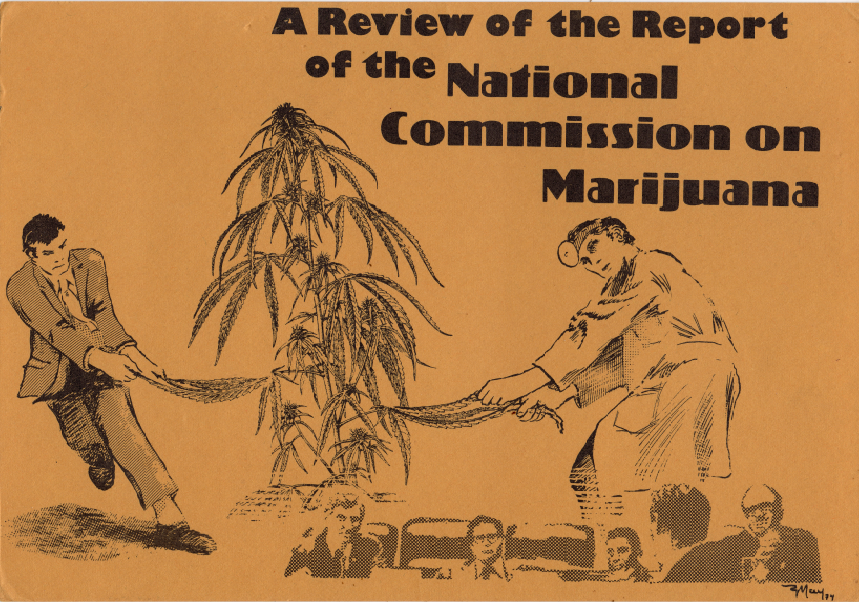
Running Time : 29 Minutes : 16 MM : Color
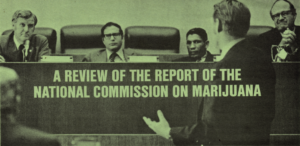
It is estimated that 24 million people in the United States have smoked marijuana. But how much do we really know about the drug? In 1970 President Nixon appointed a commission to study marijuana. It is the most comprehensive study ever made in the Untied States, a landmark report that cannot be ignored. Based upon the findings of that commission, this film answers those questions most often asked about marijuana.
- What is Marjuana?
- What kind of person smokes Marjuana? And why?
- Is Marijuana addictive?
- Does Marijuana cause crime or aggressive behavior?
- Is Marijuana a threat to the Society?
- Does Marijuana lead to Heroin or other dangerous drugs?
- Is Marijuana a stimulant or a depressant?
- Does Marijauana cause birth defects?
- How does Marijuana use affect the body?
- Does Marijuana vary in strength?
- Is Marijunan less harmful than alcohol?
- The Commission recommends decriminalization. What is decriminalization?
Dear Roy
” Your documentaries have great historical value and I treasure the hope you resuscitate your early pioneering work on marihuana. Its human brain receptors are the most abundant receptors in our brains. We are not talking ‘recreational’, but fundamental facts of being human.”
– Francisco Gomez Mont Avalos is doctor surgeon UNAM graduate. 25 years ago he participated with Juan Corona and Nora Volkow in Mexican pioneering research with positron emission tomography. Today is professor of communication at the Faculty of Political and Social Sciences of UNAM and professor of mathematics and visual cognition of students of design and architecture at the Universidad Iberoamericana.